An “AI visibility” number means little unless the report says how it was produced. This guide shows how to measure AI search citations without overstating them. It sets out the error sources behind the counts, works through SEOIndia’s own dated baseline as an example, and ends with a report format a client can check line by line.
The short answer: an AI citation report is a sample
An AI citation report describes a sample of answers. A business can run a fixed set of prompts on named engines, under stated conditions, and record what each answer contained. It cannot see how often its name appears across every conversation in which real buyers ask similar questions. Google’s Search Console gives no such count. Microsoft’s Bing Webmaster Tools reports a narrower one: citations of a site’s pages shown as sources in Microsoft Copilot, AI summaries in Bing and select partner integrations.
So the honest unit is the sample. Each number earns trust only when the report says which prompts ran, when, and how the answers were captured.
Repeat runs matter because answers move. The same prompt can return a different answer on the next run, and a preprint on measuring visibility in AI search argues that one-off observations are unreliable for that reason (arXiv preprint).
Microsoft’s AI Performance report in Bing Webmaster Tools, launched as a public preview, shows the total number of citations displayed as sources in AI-generated answers across Microsoft Copilot, AI summaries in Bing and select partner integrations (Microsoft Bing Blog). SEOIndia’s own Bing Webmaster Tools reading so far covers search impressions, not AI citations, so the baseline below has no Bing row.
Four events that get reported as “being cited”
An AI answer can involve a brand in four different ways. Folding all four into one word, “cited”, inflates the count.
Mention versus citation, linked citation and recommendation
- Mention. The answer text names the brand.
- Citation. The engine lists a page from the brand’s own site among its sources.
- Linked citation. The listed source is a link the reader can open. A source printed as plain text is still a citation, yet it gives the reader no link to click.
- Recommendation. The answer advises the reader to consider or choose the brand. Appearing as one name in a list of providers counts only as a mention.
These events do not move together. A brand can be named and even recommended while another site supplies the source the engine shows. One blended figure hides that.
SEOIndia’s own observation record keeps mention, citation, linked citation and recommendation as four separate required fields, and nothing can be marked recommended unless it was also mentioned. The rules behind that record are set out in how we measure AI search visibility.
Google’s Search Console records a different kind of event. A click on a link to an external page in an AI Overview counts as a click, and the whole AI Overview occupies a single position in the results, according to Google Search Console Help. That data shows impressions and clicks. It gives no count of mentions or citations.
Sampling error: a prompt set is not the market
Every AI citation report rests on a list of prompts that somebody chose. The result describes that panel.
Our own Search Console data, which lists only the queries that surfaced seoindia.co and omits anonymised ones, shows how far a panel can sit from the demand we can see. In the 90 days from 24 July to 21 October 2026 (web search type, final data), the seoindia.co queries that named AEO, GEO, answer engines, ChatGPT or AI search, or asked about citations, numbered 100. They drew 1,576 impressions, 1 click and an impression-weighted average position of 82.6. Only 2 of those queries asked how to get a business cited, with 27 impressions and 0 clicks. None of the disclosed queries asked how to measure or track citations. No query in the pull named Perplexity or AI Overviews.
Search Console cannot close that gap. Google Search Central says AI Overviews and AI Mode are reported in the Performance report within the Web search type, so query rows do not show which searches produced an AI answer, or whether it named a source. Over the same 90 days, the page for our AEO agency in India service recorded 893 impressions, 1 click and an average position of 82.1. Those figures count how often the page was shown in search. They do not count AI citations.
A prompt panel is still useful when it is built and labelled with care:
- Draw prompts from questions buyers actually ask, such as enquiry forms, sales calls and Search Console query rows.
- Record the panel size and the prompt suite version beside every count.
- Report results as k of n answers for that panel, per engine and per prompt, with the run dates.
- Label the result a sample in its heading.
- Refuse to turn panel counts into market share or share of voice.
Re-run variance: the same prompt, a different answer
The preprint cited in the first section lists no journal publication on its arXiv page, and we read only its abstract.
Brand lists move too. Search Engine Journal reported a SparkToro and Gumshoe study of repeated brand-recommendation prompts in which ChatGPT and Google AI Overviews each returned the same brand list less than 1% of the time across runs of the same prompt. The study’s own page could not be retrieved, so this relies on that report. The same report notes that visibility measured across many queries was more consistent than ranking position.
- A single answer is an anecdote. It shows that a citation is possible, never how often one appears.
- Order inside an answer is unstable. A brand named first in one run may be named last, or left out, in the next.
How many runs before a change is called real
We know of no published standard that sets the number of runs, so each team chooses its own. One practitioner guide recommends running each prompt three to five times on each engine (Managed Code).
SEOIndia treats a change as real only after two consecutive scheduled runs agree. Agreement should be judged on the mention, citation, linked citation and recommendation fields for the same prompt, engine and capture method, never on the order of brands. That threshold is a considered judgement. It is not a statistically derived figure.
Account memory and signed-in sessions
An assistant answers the person in front of it. A signed-in account can carry its history, saved memory and earlier chats into a new answer. A brand the owner has asked about before can then surface where a stranger might not see it. iSEOup lists logged-in accounts, location and prior chats among the factors that change which brands an assistant names. Ahrefs warns that hand checks are easily skewed by personalised responses and by model updates.
SEOIndia met this problem in its own data. A control test on ChatGPT, recorded in the run notes, ran the same prompt in two conditions. A regular session with memory on produced a citation of seoindia.co. A Temporary Chat did not reproduce it for that prompt. Yet one Temporary Chat answer in the same signed-in account addressed the reader as SEOIndia’s operator, and ChatGPT’s own notice says a Temporary Chat can still reference memory. So we do not treat Temporary Chat as a clean mode. We treat that citation as contamination in one account, and it is in no total. ChatGPT was excluded from the 20 September 2026 baseline altogether. A citation that appears only for the brand owner tells a client little about what buyers see.
Capture conditions that keep results comparable
- Signed out by default. SEOIndia’s default method is a person running each prompt by hand in an ordinary browser, signed out.
- A closed list of methods. Three alternatives are permitted: a signed-in session with memory and chat history off, an approved grounded API route, and browser automation. An API answer can differ from what the app shows a buyer, so API rows should be reported apart from browser rows.
- The method on every row. Each record states which of the four methods produced it, because the methods are not equivalent. A report should never blend them into one count.
- No personal-account citation in a baseline. A citation seen in an account with memory or chat history on can prompt a signed-out re-test. It cannot count toward a baseline.
If an agency or a tool cannot say how a result was captured, treat that result as unverified. What makes a page worth citing is a separate question, covered in our guide on how to get a business cited by ChatGPT.
Access comes before citation
A citation count only means something if the engine could reach the page first. An engine whose search crawler is turned away has little route to show that site as a source. OpenAI says a site opted out of OAI-SearchBot will not be shown in ChatGPT search answers, though it can still appear as a navigational link.
OpenAI and Perplexity each use their own search crawler, controlled separately in robots.txt. OpenAI states that “OAI-SearchBot is used to surface websites in search results in ChatGPT’s search features.” Perplexity describes PerplexityBot as designed to surface and link websites in its search results.
Google works differently. It says there are no additional requirements to appear in AI Overviews or AI Mode, and that a supporting link must be indexed and eligible to show with a snippet in ordinary Search (Google Search Central).
What the access check records
- The robots.txt rules that apply to OAI-SearchBot, PerplexityBot and Googlebot, including any rule under the wildcard user agent.
- Whether the pages you expect to be cited return HTTP 200 and are indexable.
- The date of the check, written beside the citation run, so a change in access can be told apart from a change in answers.
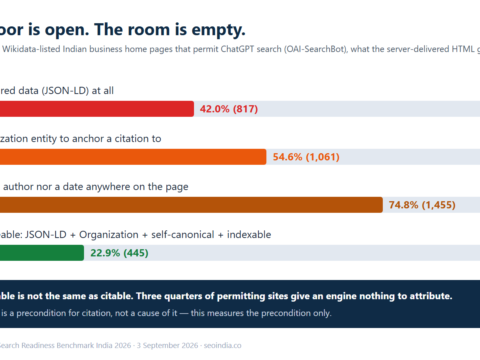
Our AI search readiness benchmark is a census of Wikidata-listed Indian business websites, collected on 3 September 2026, 16:26-21:47 UTC. Of its 1,948 reachable home pages, 4 (0.2%) disallowed OAI-SearchBot at the root and 7 (0.4%) disallowed PerplexityBot at the root. That census does not measure why a site allows or blocks a crawler, pages beyond the home page, or whether any AI engine cites a site.
A clean robots.txt is a precondition. It does not explain a zero, and it does not predict a citation.
A worked example: SEOIndia’s own baseline of 20 September 2026
On that day we ran a versioned prompt suite, v3-20260920, for SEOIndia’s own site, seoindia.co. The prompts, the engines and the scoring rules are set out in the full prompt-suite method.
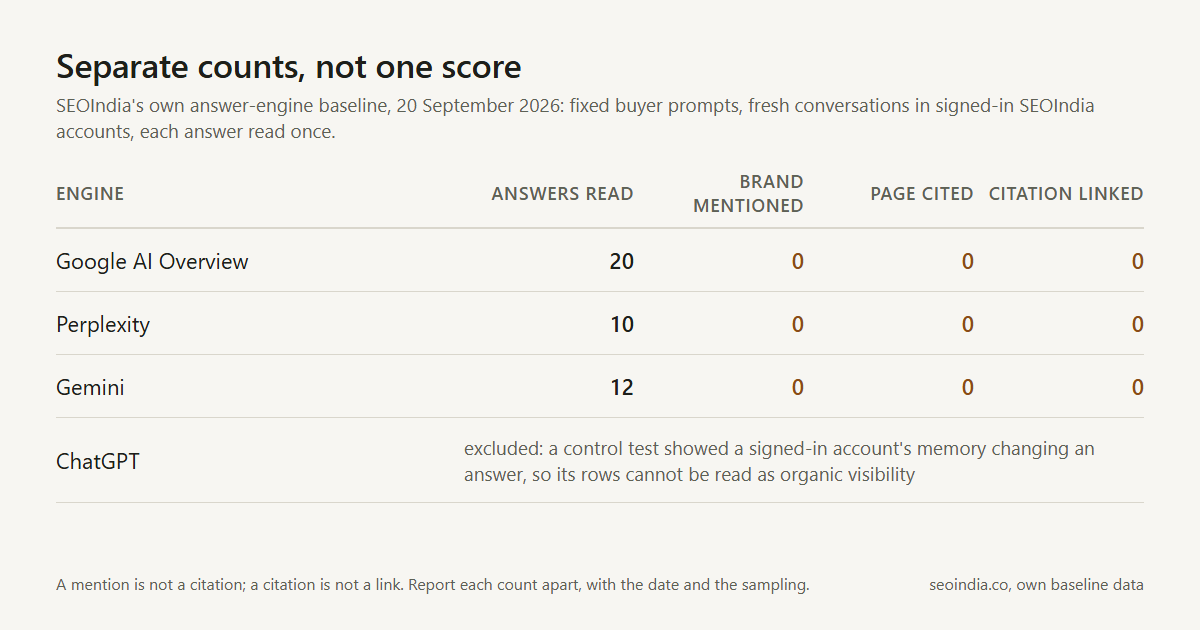
The run produced 54 completed answers, and 42 of them are counted here: 20 on Google AI Overview, 12 on Gemini and 10 on Perplexity. The other 12 are ChatGPT’s, excluded below. Perplexity completed 10 of its 12 assigned prompts. The other two hit a free-plan quota wall. They are recorded as blocked, because a blocked run is not an answer, and they stay out of the denominator.
That run did not use our default method. Every counted answer was captured in a signed-in browser session on SEOIndia’s own accounts, and each row of the record says so. Each prompt was pasted verbatim into a fresh conversation and run once per engine on that date. The prompts came from the fixed suite and were run from India in English (Gemini’s location was assumed rather than shown by the interface); Google answered all 20 of its prompts, Gemini all 12, and Perplexity 10 of 12. A zero from a single pass means none was seen in that pass. It does not show that the rate is zero.
A signed-in session can add personalisation, the error the ChatGPT control test caught. The run record flags it for the three counted engines too. The Google account had personalisation on. The Perplexity account held earlier chats, at least one about choosing an agency in India, and its memory setting was not recorded. Gemini was the only account shown with its activity history off. In our one ChatGPT test, personalisation added a citation of the owner’s brand rather than removing one, and no mention or citation appeared on the three counted engines, so the zeros stand as a signed-in reading, not as a clean one. ChatGPT’s answers were excluded because a control test showed its memory changing an answer.
The result was 0 SEOIndia mentions and 0 citations: 0 of 20 on Google AI Overview, 0 of 12 on Gemini and 0 of 10 on Perplexity. With no mention and no cited source, there was nothing to mark as a linked citation or a recommendation either.
What this baseline does not show
- It says nothing about Bing or Microsoft Copilot.
- It records no access check for seoindia.co on the run date.
- It says nothing about ChatGPT. Its 12 answers came from a signed-in account whose memory changed an answer in a control test, so none can be read as organic visibility; they are excluded, not counted as zero.
- It makes no claim about any other brand, sector or market.
- It is one brand on one date, the first and so far only point in our own series, and offers no benchmark for anyone else.
- It cannot be compared with a later signed-out run without noting the change of method. Later runs follow the two-run rule above.
An engine’s answer is not a business outcome
A citation shows that an engine listed a page as a source in one sampled answer. It does not show that anyone read that answer, clicked the source or got in touch.
Published click data shows why the separation matters. In US browsing data from March 2025, Pew Research Center found that Google users who saw an AI summary clicked a traditional search result in 8% of visits. Users who saw no summary clicked a result in 15% of visits. The same study found that users rarely clicked a link inside the summary itself. A page that is cited in a summary may therefore still receive few visits from it.
A client report should keep four things apart: citations from the sampled answers, referral clicks from analytics, enquiries the business can trace, and revenue from the client’s own records where known. A rise in citations with no change in clicks or enquiries is still worth recording as a visibility signal.
A client report format a client can check
A sound AI citation report puts the capture conditions beside every count. This format is SEOIndia’s own proposal, not a published standard. The table lists the fields to hold for each answer.
| Field | What it records |
|---|---|
| Engine | The AI surface that answered. |
| Prompt id and suite version | Which prompt ran, from which fixed suite version. |
| Date and time | When the answer was captured. |
| Capture method | Signed out; signed in with memory and chat history off; API; or automation. The memory and history state is recorded for each engine. |
| Location and language | The country, language and device the answer was captured from. |
| Completed versus blocked runs | Answers received, and runs that hit a quota or error. |
| AI answer shown | Yes or no: for a search engine, whether an AI answer appeared at all. A query with no AI answer is reported apart, never as a hit or a miss. |
| Mention | Yes or no: the brand is named in the answer text. |
| Citation | Yes or no: the brand’s own page is listed as a source. |
| Linked citation | Yes or no: the reader can click that source. |
| Recommendation | Yes or no: the answer advises using the brand. |
| Cited URL | The exact page shown as the source. |
| Evidence | A screenshot or verbatim excerpt of the answer and its source list, captured at the time. No evidence, no observation. |
| Run-to-run agreement | Whether the result matched the previous scheduled run. |
Referral clicks from analytics and enquiries the business can trace belong in a separate block below the table.
What the report should refuse to publish
- A blended “AI visibility score”. It merges events the table keeps apart.
- An “AI ranking position”. An AI answer has no fixed results page to rank in.
- A share-of-voice percentage from any prompt panel. A panel describes its own prompts, not a market.
- A citation from a signed-in session with memory or chat history on, or from any run with no capture method recorded.
- A screenshot without its run record. It cannot be repeated.
How to check a report you have been sent
- Ask for the captured answers behind a few counts you pick at random.
- Open every cited URL. A third-party page that names you is a source that mentions you. It is not your citation, and it counts as a mention only if the answer text itself names you.
- Re-run a few prompts yourself, signed out, in a fresh conversation, on the same engine. Expect different wording; compare only the mention, citation, linked citation and recommendation fields.
- Ask for the number of runs beside every count, and for the blocked runs.
- Ask which data source each figure came from: sampled answers, Search Console, Bing Webmaster Tools or analytics.
A report built this way may show small numbers, and sometimes zeros, each of which can be checked.
To apply this format to your own brand, see our AI search SEO service.
Frequently asked questions
What is the difference between a mention, a citation and a linked citation?
A mention is the brand named in the answer text. A citation is one of the brand’s own pages listed as a source. A linked citation is a source the reader can click. They are counted apart because a mention without a source can be checked only against the captured answer text, and a source shown as plain text gives the reader no link to open.
Why did an assistant cite us yesterday and not today?
Answers vary between runs of the same prompt, and a preprint argues that one-off observations are unreliable. Signed-in accounts, memory and earlier chats can also change what an assistant names. Before reading anything into the change, check that both runs used the same prompt, the same engine and the same capture method, with the browser signed out.
How many runs are needed before reporting a change to a client?
We know of no published standard that sets a number. SEOIndia counts a change only after two consecutive scheduled runs agree, and states that this is a considered judgement with no statistical test behind it. Report each result as a count of answers out of answers run, per engine and per prompt, with the run dates beside it.
Does Search Console show AI Overview citations?
No. Google reports AI Overviews and AI Mode within the Web search type, and an AI Overview occupies a single position in the results. That gives impressions and clicks with no citation count. Bing’s AI Performance report, launched as a public preview, counts citations for Microsoft Copilot, AI summaries in Bing and select partner integrations. SEOIndia’s own Bing reading so far covers search impressions, not AI citations, so this article has no Bing AI-citation baseline.