What 1,948 Wikidata-listed Indian business websites tell an AI engine when it comes to cite them.
SEOIndia original research. Census collected 3 September 2026. The methodology, the instrument, the dataset and the script that recomputes every number in this report are published with it.
The answer first
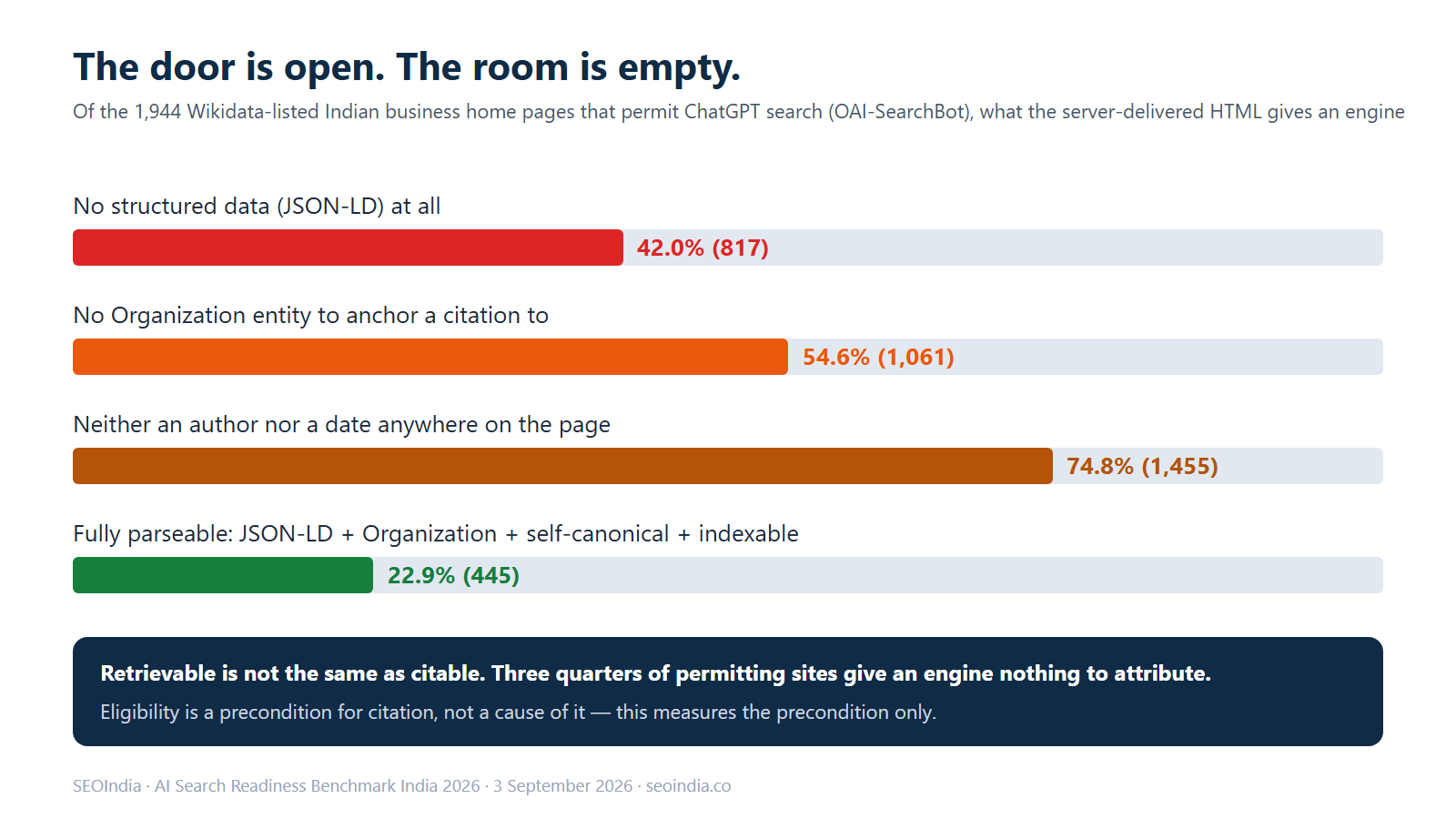
Almost no Wikidata-listed Indian business website in our census blocks AI search crawlers: 4 of 1,948 reachable home pages disallow OpenAI’s search bot at the root. But being allowed in is not the same as being citable. Of the 1,944 home pages that permit AI search, 817 serve no JSON-LD structured data at all and 1,061 expose no Organization entity an engine could attribute an answer to. Only 445 of 1,944 (22.9%) clear all four preconditions we measured for being retrieved, parsed and attributed: JSON-LD present, an Organization entity, a self-referencing canonical, and no noindex directive. Author and date are counted separately: 1,455 of the 1,944 show neither on the home page. The gap in India’s AI-search readiness is not access. It is legibility.
1. Why this study exists
Most claims about “AI search readiness” are opinions dressed as numbers: a vendor’s client base, a handful of screenshots, a survey of people who already care. We wanted a measurement that anyone could repeat without trusting us. So we built a census with a public frame, a fixed instrument and one rule: every headline carries its own denominator, and the wording never says more than the measurement can.
The question is practical. When a generative engine such as ChatGPT, Perplexity, Gemini or Google’s AI Overviews assembles an answer to a commercial question, it needs three things from a website before it can cite it: permission to fetch, a page it can retrieve, and a page it can parse into an entity with a name, an author and a date it can trust. A business can be excellent at classic SEO and still fail the third step, because nothing in a ranking report tells you whether your home page describes itself in a form a machine can read.
This benchmark measures those three steps, in that order, across a population defined by someone other than us.
2. How we measured
Population. Every Indian business with an official website recorded in Wikidata, collected 3 September 2026: 4,116 Wikidata rows, collapsed to 2,596 distinct hosts after removing duplicates across entities. We call this “Wikidata-listed Indian business websites in the measured census” throughout, and we do not generalise it to “Indian businesses”: the Wikidata frame over-represents companies large or notable enough to have an entry.
Instrument. One request to each host’s home page plus its robots.txt, with the user agent SEOIndia-AISearchReadinessStudy/1.0 (+https://seoindia.co/; research; one page per host) and a 1.5 second delay between hosts. Redirects were followed and the final host recorded. Hosts whose robots.txt disallowed all user agents were not fetched, by design, and are counted as unreachable in the run. Server-delivered HTML only: nothing injected by JavaScript is seen, which makes every “has no schema” figure an upper bound on the true share.
Reachability. 1,948 of 2,596 hosts (75%) answered; 648 (25%) did not. The unreachable group is not one thing: 181 names did not resolve, 127 answered HTTP 403 to our agent, 79 refused the connection, 77 failed TLS trust, 46 answered a permanent redirect our client does not follow, 38 timed out, 21 disallowed all agents in robots.txt, 11 answered 404, and the rest were assorted connection failures. Every “permitting” and “parseable” share below is computed on reachable hosts only, and says so.

Reproducibility. We re-probed a seeded sample of 60 hosts the next day. 59 of 60 were reachable again; the one failure was a timeout. Eight of twelve measured fields agreed on all 60 hosts, and every disagreement traced to that single transient host. The frame file, the run CSV, the sample list and the verification script ship with this report so a reader can reproduce any row.
| What is measured | Numerator / denominator | Collection | Exclusions | Limitation |
|---|---|---|---|---|
| Reachable home pages | 1,948 / 2,596 hosts in the frame | 2026-09-03 16:26–21:47 UTC | none | one attempt per host; some slow hosts are counted as unreachable |
3. Findings
3.1 AI crawler posture: search access is open, training is where sites draw the line
Among the 1,948 reachable home pages, 4 disallow OpenAI’s search crawler (OAI-SearchBot) at the root of robots.txt. That is 0.2%. Blocking of Perplexity’s crawler is similarly rare: 7 hosts. Training crawlers are a different matter: 102 hosts block GPTBot (5.2%), 115 block CCBot (5.9%), and 121 (6.2%) block at least one of the four agents we checked. Taking OpenAI’s two crawlers on their own, 98 hosts block GPTBot (training) while permitting OAI-SearchBot (search); 4 block both; none block OAI-SearchBot while permitting GPTBot.

The pattern is coherent. Where an Indian business has taken a position on AI crawlers, it has chosen to keep its content out of training corpora while leaving the door open to being found and cited. That is a defensible commercial choice. What is striking is how few have taken any position: 1,827 of 1,948 (93.8%) block none of the four agents we checked, 1,846 (94.8%) block neither GPTBot nor OAI-SearchBot, and 272 have no robots.txt at all.

| Measure | Numerator / denominator | Value | Limitation |
|---|---|---|---|
| Blocks OAI-SearchBot | 4 / 1,948 reachable | 0.2% | root-level Disallow only; path-level rules not counted |
| Blocks GPTBot · CCBot · any of four | 102 · 115 · 121 / 1,948 | 5.2% · 5.9% · 6.2% | under-count for the same reason |
| No robots.txt | 272 / 1,948 | 14.0% | absence of a file, not a policy |
Because 99.8% of reachable hosts permit AI search, the rest of this report is computed on the 1,944 permitting hosts. The four that block are excluded from every downstream share so that “permitted but unreadable” is measured on sites that actually asked to be read.
3.2 Retrieval eligibility: the basics are mostly in place
1,941 of the 1,948 reachable home pages are served over HTTPS. 23 carry a noindex directive on the home page, which in most cases is a misconfiguration rather than a decision. 1,288 declare a sitemap in robots.txt. 701 carry a self-referencing canonical; 141 resolve to a different host than the one in the frame, usually a www or brand-domain redirect that was recorded but not penalised.
Retrieval, in other words, is rarely the barrier. A generative engine that wants to fetch an Indian business home page can almost always do so. The barrier comes after the fetch.

| Measure | Numerator / denominator | Value | Limitation |
|---|---|---|---|
| HTTPS | 1,941 / 1,948 | 99.6% | final URL after redirects |
| Home page noindex | 23 / 1,948 | 1.2% | meta robots on the home page only |
| Sitemap declared | 1,288 / 1,948 | 66.1% | robots.txt declaration, not sitemap validity |
| Self-referencing canonical | 701 / 1,948 | 36.0% | exact-match test; equivalent variants counted as non-self |
3.3 Parse surface: what a machine can read once it has the page

1,131 of 1,948 reachable home pages carry at least one JSON-LD block. 886 declare an Organization entity. 343 carry a BreadcrumbList, 242 an FAQPage, and 662 publish an llms.txt file, the emerging convention for telling language models what a site is. Only 208 home pages expose an author surface and 415 a date surface.
The most common JSON-LD types tell you what the ecosystem’s plugins emit by default rather than what businesses have decided to say: Organization (843), WebSite (815), SearchAction (606), PostalAddress (547), ContactPoint (521), ImageObject (501), WebPage (449). FAQPage (242) and Person (299) are rarer because they require someone to write something.
Two numbers deserve a second look. 245 home pages carry JSON-LD without an Organization node, which usually means a theme emitted WebSite and WebPage and nobody added who the site belongs to. And 77 hosts publish an llms.txt while serving no JSON-LD at all: they adopted the newest convention before the oldest one.
| Measure | Numerator / denominator | Value | Limitation |
|---|---|---|---|
| Any JSON-LD | 1,131 / 1,948 | 58.1% | server HTML only; JS-injected schema missed |
| Organization entity | 886 / 1,948 | 45.5% | JSON-LD only; Microdata/RDFa not counted |
| Author surface · date surface | 208 · 415 / 1,948 | 10.7% · 21.3% | presence on the home page, not correctness |
| llms.txt present | 662 / 1,948 | 34.0% | file exists; content not evaluated |
3.4 The cross-tab: permitted but unparseable

This is the headline that matters, computed on the 1,944 hosts that permit AI search.
817 of them (42.0%) serve no JSON-LD structured data. 1,061 (54.6%) expose no Organization entity. 1,455 (74.8%) show neither an author nor a date on the home page; 74 show an author only, 282 a date only, 133 both. 438 declare an Organization but not a self-referencing canonical, so the entity is there but the engine has to guess which URL it belongs to.
Put the four preconditions together (JSON-LD present, an Organization entity, a self-referencing canonical, and no noindex directive) and 445 of the 1,944 permitting home pages (22.9%) are what we call fully parseable. That composite is not a quality score, and a site can be fully parseable and still say nothing useful. It is the floor: below it, an engine that wants to cite the business has to reconstruct who it is from prose.
The commercial consequence is direct. When two suppliers are equally relevant to a question and one describes itself as an entity with a name, a location and a canonical address while the other is a WebPage with a logo, the citation goes to the one the engine can name. Being open to AI search and illegible to it is the worst of both positions: you pay the crawl cost and forgo the credit.
| Measure | Numerator / denominator | Value | Limitation |
|---|---|---|---|
| No JSON-LD | 817 / 1,944 permitting | 42.0% | upper bound (JS-injected schema missed) |
| No Organization entity | 1,061 / 1,944 | 54.6% | upper bound (Microdata/RDFa missed) |
| Neither author nor date | 1,455 / 1,944 | 74.8% | home pages often carry no byline legitimately; this is a surface count, not a content judgement |
| Fully parseable (4 preconditions: JSON-LD, Organization, self-referencing canonical, no noindex) | 445 / 1,944 | 22.9% | composite; not a quality score |

3.5 Answerability and media: the page itself

931 of 1,948 home pages show a visible FAQ block; 242 of those back it with FAQPage schema and 689 do not. Heading discipline is uneven: 593 home pages have no H1, 985 exactly one, 370 two or more. Title tags: 64 are empty, 424 are under 30 characters, 970 sit in the 30–65 range, 490 run longer. Meta descriptions: 524 are missing, 163 are shorter than 70 characters, 676 sit in the 70–160 range, 585 run longer. The median home page carries 900 words, 9 lists and no tables.
Media and performance follow the same shape. The median home page carries 30 images; 753 home pages have at least one image with no alt text. Median time to first byte was 754 ms from our vantage point; 682 hosts answered within 500 ms, 529 within a second, 737 took longer than a second and 152 longer than three. The median page weighed 152 KB of HTML.
None of these are AI-specific. They are the classic SEO hygiene items, and they matter to generative engines for the same reason they matter to Google: a page with one H1, a readable title, a real description and labelled images is easier to summarise correctly. A home page with no H1 (593 of them) leaves the engine to infer the subject from the logo.
| Measure | Numerator / denominator | Value | Limitation |
|---|---|---|---|
| Visible FAQ · with FAQPage schema | 931 · 242 / 1,948 | 47.8% · 12.4% | visible-block detection by heading pattern |
| No H1 | 593 / 1,948 | 30.4% | server HTML only |
| Missing meta description | 524 / 1,948 | 26.9% | tag absent, not tag weak |
| Any image missing alt | 753 / 1,948 | 38.7% | at least one image; not a ratio of images |
| TTFB over 1 s | 737 / 1,948 | 37.8% | one request from one vantage point; not a Core Web Vitals field value |
3.6 By industry: direction only

981 of the 1,948 reachable hosts carry an industry label in Wikidata; 967 do not. Among the seven labelled sectors with at least 20 hosts, software (41 hosts) and artificial intelligence (31) lead on Organization schema at 78% and 77%, followed by e-commerce (71%, 28 hosts) and information technology (70%, 27). Automotive sits at 56% (27 hosts), retail at 50% (24), and financial services trails at 38% (21 hosts). On JSON-LD of any kind, software (90%) and e-commerce (89%) lead; financial services (62%) and retail (58%) trail.
These are observed shares in small groups, not rankings. A sector with 21 hosts moves nine points when two sites change. What the direction says is plausible and worth testing at scale: the sectors that sell software describe themselves to machines; the sectors that sell trust in person have not started.
| Measure | Denominator | Value | Limitation |
|---|---|---|---|
| Organization schema, software · AI · financial services | 41 · 31 · 21 hosts | 78% · 77% · 38% | small n; direction only; 967 hosts have no sector label |
4. What a site owner should do first: five zero-cost fixes, in order
- Declare who you are. Add an Organization node in JSON-LD on the home page with name, url, logo, sameAs to your official profiles, and a ContactPoint. This is the single change that moves a site from the 1,061 to the 883. Most CMS platforms can emit it from settings already filled in.
- Point the entity at one URL. Set a self-referencing canonical on the home page and make the Organization’s url match it. 438 sites have the entity but not the address.
- Give the home page a byline and a date where it is honest to do so. A “last reviewed” date and a named responsible person or team are surfaces engines look for when they judge freshness and accountability. Do not invent a journalist; name the business owner or the team.
- Fix the basics the engine reads first. One H1. A title between 30 and 65 characters that names the business and what it does. A meta description that a human would accept as a summary. Alt text on every image that carries meaning.
- Decide your crawler policy on purpose. If you want to be cited but not trained on, say so in robots.txt: allow OAI-SearchBot and PerplexityBot, disallow GPTBot and CCBot. 89 sites in the census have already made exactly that choice at the root of robots.txt. If you have no robots.txt at all, you have made no choice, and the default is that everything is permitted.
None of these require a budget. All of them require someone to own the answer to “what does our home page say about us to a machine”, which in most Indian businesses is nobody’s job yet.
5. Limitations, in the body where they belong
- The frame is Wikidata. It over-represents notable companies and under-represents the small businesses that make up most of the economy. Every share here is a share of this census, not of Indian business.
- One page per host. We measured the home page. A company whose product pages carry rich schema while its home page carries none is scored as having none. This is deliberate: the home page is where an engine starts, and it is the page a business controls most completely.
- Server-delivered HTML only. Schema injected by tag managers or client-side frameworks is invisible to this instrument, as it is to some crawlers. Every “has no schema” share is therefore an upper bound.
- Root-level robots rules only. A site that blocks an agent from a subdirectory is counted as permitting. The blocking shares are under-counts.
- One request, one vantage point, one day. Time to first byte is a single sample, not a field metric. Reachability includes some hosts that were merely slow on 3 September.
- Sector labels are sparse. 967 of 1,948 reachable hosts have no industry label in Wikidata, so the sector cut describes half the census and should be read as direction only.
6. Reproduce it
The frame (sample-frame-wikidata-20260903.txt, 2,596 hosts), the census output (run-20260903/aisr-india-2026-20260903-214748.csv), the 60-host reproducibility sample and its re-probe (repro-20260904/), the instrument and the verification script that recomputes every number in this report from the raw rows (publication-20260904/verify.js, output VERIFY-20260904.md) are published with this report. Run the verifier and every figure above should reappear; if one does not, the report is wrong and we want to know.
7. What this means for an Indian business in 2026
The visibility contest has moved. Ranking on a results page still matters, but a growing share of commercial questions are now answered inside an assistant, with two or three sources cited and everyone else invisible. Those citations go to pages an engine can fetch, parse and attribute. In this census, three in four of the Indian business websites that permit AI search have not done the third part.
That is bad news and good news at once. Bad, because most Indian businesses are open to being cited and are not being cited. Good, because the fixes are cheap, the field is uncrowded, and the businesses that describe themselves properly this year will be the ones the engines have learned to name by the time the rest catch up.
If you want to know where your own site sits against these 1,944 home pages, SEOIndia runs the same instrument against a single domain as a free readiness check, and our AI Search SEO practice exists to close the gap the check finds, and AI search strategy is where that work is scoped for a specific business.
Data, instrument and verification
This report is meant to be checked, not believed. Everything needed to reproduce it is published here. If a figure in this report does not reappear when you run the verifier, the report is wrong and we want to know.
- Full report (PDF, 223 KB) — the text and figures as first published on 6 September 2026; it predates the correction noted under About this research.
- Census output (CSV) — one row per host: 2,596 rows, every measured field.
- Sample frame (TXT) — the 2,596 distinct hosts, derived from 4,116 Wikidata rows.
- Verification output (Markdown) — every published number, recomputed from the raw rows.
Collection window: 2026-09-03, 16:26–21:47 UTC. Instrument: one request per host to the home page and robots.txt, user agent SEOIndia-AISearchReadinessStudy/1.0 (+https://seoindia.co/; research; one page per host), 1.5 second delay between hosts, redirects followed, server-delivered HTML only. Reproducibility: a seeded 60-host sample was re-probed on 2026-09-04; 59 of 60 were reachable again and 8 of 12 measured fields agreed on all 60 hosts, with every disagreement tracing to one transient host (ncrtc.in, timeout).
Reuse. The figures and charts in this report may be reproduced with attribution to SEOIndia and a link to this page. The charts are original renders from the census data.
Sources and definitions
The numbers in this report are primary measurement: their source is the census dataset published above, and the verification file recomputes each one from the raw rows. The references below define the things measured — the sample frame, the protocol, the four crawlers and the markup — and were each opened on 6 September 2026.
- Wikidata — the sample frame. Indian businesses with an official website (property P856) recorded as of 3 September 2026.
- RFC 9309, Robots Exclusion Protocol — the standard the robots.txt parsing in this instrument follows, including the rule that a root-level
Disallow: /for a named agent is what we count as blocking. - Google Search Central: robots.txt introduction — how robots rules are interpreted in practice, including the absence of a file meaning full permission.
- OpenAI: overview of OpenAI crawlers — the definitions that separate
GPTBot(training) fromOAI-SearchBot(search discovery), the distinction section 3.1 turns on. - Perplexity: PerplexityBot — definition of the third agent checked.
- Common Crawl: CCBot — definition of the fourth agent checked.
- schema.org: Organization — the entity type whose presence is counted in the parse surface.
- Google Search Central: organization structured data — the properties an engine expects on that entity, and the basis for the “declare who you are” fix in section 4.
Check your own site against this census
SEOIndia runs the same instrument against a single domain as a free readiness check: it reports whether an AI search agent is allowed, whether the home page carries JSON-LD, whether that JSON-LD contains an Organization whose url matches the canonical, and whether the page says who is responsible and when it was last reviewed. The four preconditions behind the 22.9% figure above are the ones defined in section 3.4: JSON-LD present, an Organization entity, a self-referencing canonical, and no noindex directive. Ask for a readiness check, or read how the work is scoped in AI Search SEO.
Frequently asked questions
Does this study show that Indian businesses block AI?
No. It shows the opposite for this census: 4 of 1,948 reachable Wikidata-listed Indian business home pages block OpenAI’s search crawler at the root. Blocking is concentrated on training crawlers, and even there it is under 7%.
Why is “no structured data” called an upper bound?
Because the instrument reads server-delivered HTML only. A site that injects JSON-LD with JavaScript is counted as having none. The true share without schema can only be lower than 42.0% of permitting hosts, never higher.
Is 22.9% “fully parseable” a quality score?
No. It is the share of permitting home pages that clear four preconditions: JSON-LD present, an Organization entity, a self-referencing canonical, and no noindex directive. A fully parseable page can still be thin. An unparseable page cannot be attributed no matter how good it is.
Can I apply these numbers to my sector?
Only as direction. Sector groups in the census are small (21 to 41 hosts), and half the reachable hosts carry no sector label in Wikidata. Use the sector cut to decide what to test on your own site, not to rank industries.
How do I check my own site the same way?
Fetch your home page and robots.txt as a crawler would, then ask four questions: is an AI search agent allowed, is there JSON-LD, does it contain an Organization with a url that matches your canonical, and does the page show who is responsible and when it was last reviewed. The published instrument does exactly this for one host, and SEOIndia will run it for you on request.
About this research
Published by SEOIndia, Noida, India. Author: the SEOIndia research team. First published: 6 September 2026. Census collected: 3 September 2026. Verification last run: 6 September 2026.
Corrections and reproduction failures should be sent to SEOIndia; a correction notice will be added to this page rather than a silent edit. This page is the canonical home of the benchmark and will carry any future revision, dated.
Correction. A re-check on 14 September 2026 against the published census rows found four errors in the text, now corrected above; the census data, charts, downloads and verification output are unchanged. First, section 3.1 said 1,846 of 1,948 (94.8%) “block none of the four agents”. 1,846 is the count that blocks neither GPTBot nor OAI-SearchBot; because 121 hosts block at least one of the four agents, the count that blocks none of them is 1,827 (93.8%). Second, the 98 hosts described as blocking “a training agent while permitting search agents”, and the 4 that block both, were counted on OpenAI’s two crawlers only, and are now labelled that way. Third, section 4 said 98 sites had made exactly the choice of allowing OAI-SearchBot and PerplexityBot while disallowing GPTBot and CCBot; counted across the four agents, the figure is 89. The 1,827 and the 89 are counted from the census CSV above; they are not separate lines in the verification output. Fourth, the opening summary placed the author-and-date count beside “all four preconditions”, and the readiness-check section described the four preconditions differently from section 3.4; both, and the fully parseable row of the section 3.4 table, now name them as the methodology defines them: JSON-LD present, an Organization entity, a self-referencing canonical, and no noindex directive. The PDF download predates this correction.