Assistants cite sources they can reach, parse, and verify. In practice that means: allow the search-side crawlers, publish pages that answer a specific question near the top, keep facts consistent across your site and your public profiles, and mark up entities clearly. There is no submission form and no paid placement — citation is earned by being the clearest available source.
Most requests we get for this work arrive phrased as “get us ranking in ChatGPT”. That phrasing is the first thing worth correcting, because it points at the wrong mechanism — and the wrong mechanism leads to the wrong spend. Here is what actually happens when an assistant names a source, and what you can genuinely influence.
Why citation is not ranking
Retrieval happens at answer time
Classic search builds an index in advance and returns an ordered list. When an assistant answers a question with links, it usually does something different: it rewrites your question into one or more searches, retrieves a small shortlist of pages at that moment, reads the passages it can parse, and composes a reply from the ones it can reconcile with each other. The selection happens live, against a question you never saw, from a pool of a few sources rather than ten positions.
That has three consequences. Your page competes as a passage, not as a document. The shortlist is small, so being “close” is worth little — you are either retrieved or you are not. And because the model rewrote the query, the phrasing you optimised for may never have been searched.
A threshold, not a leaderboard
Position is a spectrum; citation behaves more like a threshold. A page either clears the bar of being reachable, on-topic at passage level, and internally consistent, or it is not quoted at all. So the work looks less like chasing incremental positions and more like removing every reason a machine might discard you — which is also why the honest scope here is influence, not control. We covered the wider shift in what AI SEO actually changes; this is the narrower version for one surface.
Step 1 — Decide crawler access per bot
Your `robots.txt` now carries a policy decision it never used to. AI providers run separate crawlers for separate purposes, and treating them as one group is the most common mistake we see.
OpenAI, for example, publicly documents distinct user agents: OAI-SearchBot supports its search features — the fetching that lets an assistant retrieve and cite a live page — while GPTBot is documented as the crawler used for model training. Other providers publish their own agents. These are different questions with different answers:
- Search-side crawlers are how your page becomes retrievable at answer time. Block them and you have opted out of citation on that surface.
- Training crawlers feed model development. That is a separate business decision — some publishers allow it, some do not, and neither position is obviously wrong.
Whatever you decide, decide it deliberately, per bot, and verify the current user-agent names against each provider’s own documentation on the day you edit the file. Those names change, and a stale robots.txt rule is silent — nothing tells you it stopped matching.
Step 2 — Write pages that answer rather than build up
Assistants quote passages, not pages. The editorial change follows directly.
Put the answer first
Open the page with a direct, self-contained answer of roughly 40–60 words that a reader — or a model — could lift out whole and still be correct. Then supply the depth. This inverts the usual article shape, where the point arrives after several paragraphs of build-up, and it is the highest-leverage change most sites can make.
Use question-shaped headings
Head sections with the question a customer would actually ask, not an abstract noun phrase. “How much does an SEO audit cost?” is retrievable; “Investment considerations” is not.
Make each section survive on its own
Write sections that make sense when quoted alone. Name the subject instead of writing “it” or “as mentioned above”. If a section only makes sense in sequence, it will be discarded when the model needs one clean passage.
Step 3 — Make your facts checkable
An assistant cross-references what it retrieves. Contradictions are cheap for it to detect and expensive for you.
- Consistency across properties. The same business name, address, service description, and founding details on your site, your business profiles, and any third-party listings. Where those disagree, the model cannot know which version is right, and the safe move is to cite something else.
- Dates, sources, and named authorship. Claims with a date and a linked source are verifiable. Claims without them are not, and unverifiable text is the first thing dropped when a model reconciles sources.
- No unevidenced superlatives. “India’s leading” survives no cross-check at all. Specific, checkable statements — years in operation, where you are based, what you actually do — survive every one.
Step 4 — Make the entity unambiguous
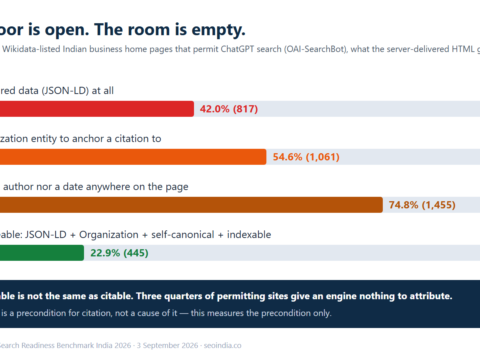
Use `Organization` markup with `sameAs` pointing only at profiles that genuinely exist and genuinely belong to you. Check whether you collide with a similarly named business in another city or sector; if you do, the disambiguating signals — address, sector, founder name, consistent description — need to be present everywhere, not just on your homepage.
Structured data here is corroboration, not decoration. Never mark up reviews or ratings you do not actually hold. Our GEO and AEO guide covers schema in more depth.
How to test whether it worked
Two methods are honest, and both have limits you should state in any report.
Dated, repeatable prompt sampling. Write down the exact prompts your customers would ask. Run them on the major assistants at a fixed interval, recording the date, the prompt text, and the sources named. A dated series is evidence of a trend; a single screenshot is an anecdote. Expect variation between sessions — assistant output is non-deterministic, and the same prompt can return different sources on different days without anything on your site changing.
Referral hostnames in analytics. Segment `chatgpt.com`, `perplexity.ai`, `copilot.microsoft.com` and similar. Volumes are small on most sites today, so read quality alongside quantity. On seoindia.co, in GA4 over the 28 days to 31 July 2026, chatgpt.com referrals showed a 66.67% engagement rate against 61.76% for Google organic in the same window. That is one site, one 28-day window, and a small number of sessions — we quote it as an observation, not a benchmark, and we do not extrapolate it to any other site.
What is not measurable
Say this part out loud to anyone selling you reporting: you cannot currently measure how often you are cited without a click, what share of all relevant answers name you, or why one session cites you and the next does not. Nothing available today sees inside those answers at population scale, and a report claiming precision on them is claiming more than the tooling can deliver.
What does not work
- Hidden text or instructions aimed at models. Trying to instruct a model from inside your page is a manipulation tactic, it is detectable, and it risks your whole domain for a speculative gain.
- Mass-generated pages. Near-duplicate content is worse here than in classic search, because reconciling sources is exactly what the model is doing.
- Anything sold as a guaranteed citation. There is no submission form, no paid placement, no partner list, and no provider with a relationship that gets you named. Nobody — us included — can guarantee a citation in an AI answer. A provider who promises one has told you what their reporting will be worth.
Where this fits
Almost everything above is recognisable good SEO with a sharper edge: crawlability, clear structure, verifiable facts, unambiguous entities. That is deliberate, and it is the realistic remit of a ChatGPT SEO expert in India or anywhere else. The genuinely new work — per-bot crawler policy, answer-shaped structure, dated citation sampling — sits on top of the fundamentals rather than replacing them. That is how our AI search SEO service is scoped: one programme covering conventional search and the answer engines together, with the measurable and the not-yet-measurable labelled honestly, and no guarantees attached to either.
Book an AI search consultation →
Frequently asked questions
Can you submit a website to ChatGPT for inclusion?
No. There is no submission form, no directory, no paid placement, and no application process for being cited in ChatGPT’s answers. Sources are retrieved at answer time from the open web. The only levers you control are whether the search-side crawlers can reach your pages, and whether those pages are clear, consistent, and genuinely useful enough to be quoted.
Does blocking AI crawlers hurt my visibility in assistants?
It depends which crawlers you block. Blocking a documented search-side agent such as OAI-SearchBot removes your pages from what an assistant can retrieve and cite live. Blocking a training crawler such as GPTBot is a separate decision with different consequences. Check each provider’s current published user-agent list before editing robots.txt, since these names are updated over time.
Why does the same prompt return different sources on different days?
Because assistant output is non-deterministic, and the live retrieval step returns a different shortlist depending on the rewritten query, timing, and available sources. Nothing needs to have changed on your site. This is why credible reporting uses a dated series of repeated prompts rather than a single capture, and why any claim of a fixed “position” inside an assistant is unsound.
Can anyone guarantee a citation in an AI answer?
No, and that includes us. There is no mechanism through which any agency, consultant, or vendor can promise that an assistant will name your business. What can be done is remove every reason you would be excluded — access, clarity, consistency, verifiability — and measure honestly afterwards. Treat a guarantee as a signal about the provider, not about your prospects.