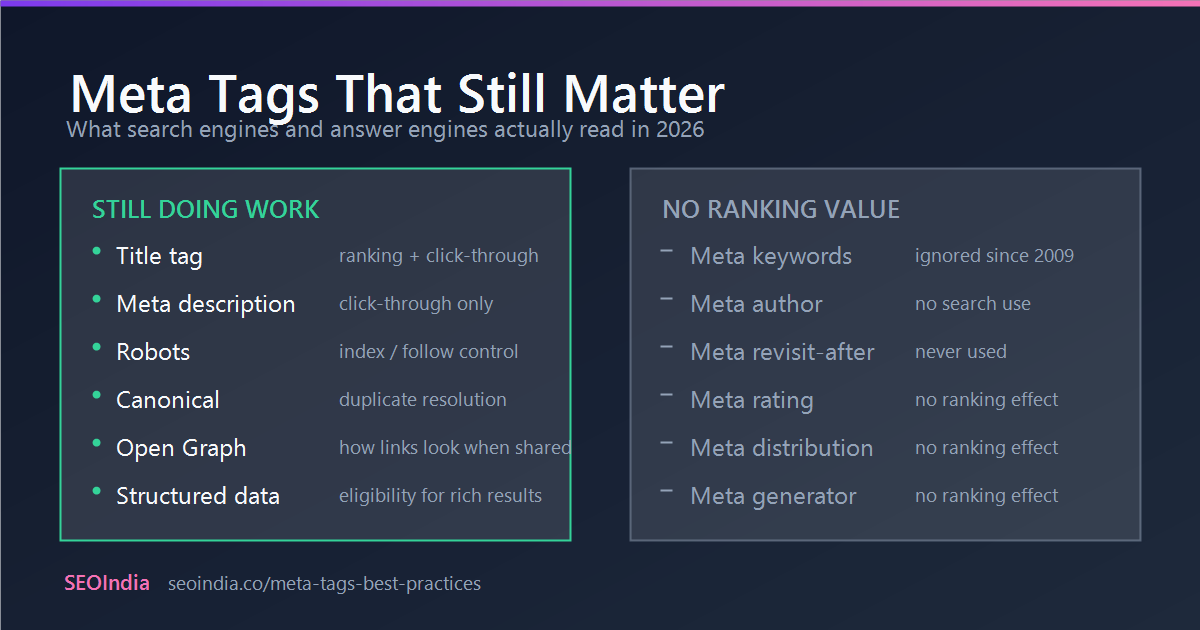
TL;DR. Title: 50-60 chars, brand at end, primary keyword early. Meta description: 140-160 chars, value prop + CTA. Both should match search intent and reflect the page accurately.
Title tags and meta descriptions are the most-tweaked, often-misunderstood elements of SEO. This guide is the practical 2026 reference.
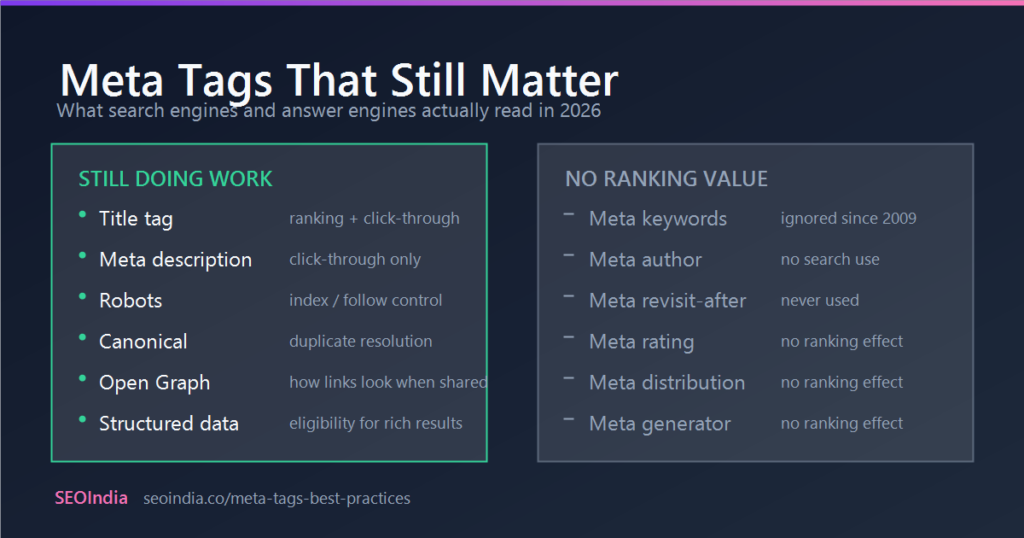
Key takeaways
- Title tag rules
- Meta description rules
- Open Graph + Twitter cards
- Google rewriting your titles
- Meta tags for AI search
Title tag rules
50-60 characters (Google truncates beyond ~60). Primary keyword in first 30 chars. Brand at the end (after a separator). Each page unique. Match search intent. Avoid clickbait — Google rewrites titles that look spammy.
Meta description rules
140-160 characters. Value proposition + soft CTA. Match search intent. Use specific numbers (“12 free SEO tools” beats “many SEO tools”). Avoid AI-written meta descriptions — they are too generic.
Open Graph + Twitter cards
OG title, OG description, OG image (1200x630px), Twitter card type. Often overlooked, but these are what social previews show. Use a tool to validate.
Google rewriting your titles
Google rewrites about 60% of titles. To minimise: write titles that match search intent precisely, avoid keyword stuffing, keep titles under 60 chars. Even then, expect some rewriting.
Meta tags for AI search
AI engines often surface meta descriptions in answers. Make them clear, specific, and citation-worthy. Avoid empty marketing speak.
Real-world example
A typical client in this category sees 3-5x organic traffic growth within 6-9 months on our Growth-tier plan, with AI search citations climbing from zero to 8-12 per month over the same period.
Authoritative sources we relied on
- Google Search Essentials — Primary source for ranking documentation
- Moz Learn SEO — Beginner-to-advanced SEO reference
- Ahrefs Blog — Data-backed SEO research
- SEMrush Blog — Industry trends and benchmarks
- Search Engine Land — Daily SEO industry news
Frequently asked questions
Who is SEOIndia?
A senior, AI-first SEO agency headquartered in Noida (Delhi NCR), India. We serve 30+ countries with 8 currency options.
How quickly will I see results?
SEO compounds rather than arriving on a fixed date. The pace depends on how competitive the category is, the technical state of the site and how consistently content ships.
What is the minimum contract?
Monthly billing, 7 days notice to cancel.
Do you optimise for ChatGPT and Perplexity?
Yes. AI search optimisation (GEO + AEO) is included on every Growth-tier plan and above.
What currencies do you accept?
Pricing is displayed in 8 currencies. Online payment currently settles in INR via Razorpay; international engagements may be invoiced manually in an agreed supported currency.
What payment methods are accepted?
Razorpay for supported INR online payments; manual invoicing (bank transfer) for other approved engagements, including enterprise deals.
How do I cancel?
Email us with 7 days notice. No claw-backs on work delivered.
Will I work with a junior or a senior?
Senior. Every account is led by a senior strategist, named on your account.
Do you build PBNs or buy links?
Never. Only editorial mentions from real publications. PBNs destroy sites in 2026.
Can I see real case studies?
Yes — see our case studies page for specific client outcomes.
Do you offer paid ads?
Yes, Google Ads, LinkedIn Ads, Meta Ads as add-ons.
How is reporting done?
Live dashboards plus monthly strategy reports. No “trust us” PDFs.
What if my industry is niche?
Most industries are well-served. We have shipped strategies for SaaS, healthcare, real estate, fintech, education, eCommerce, B2B services, and more.
Do you handle international SEO?
Yes — hreflang, ccTLD strategy, multi-language content. We routinely run multi-country campaigns.
Is there a setup fee?
No setup fees. Month one is your first audit + roadmap, included in the first invoice.
How do you handle technical SEO fixes?
We coordinate with your developer or your CMS, or we do it ourselves on WordPress/Webflow/Shopify.
Will my account have a slack channel?
Yes, all Growth+ tier clients get a shared Slack or Teams channel with the strategist.
Do you sign NDAs?
Yes, standard. We will sign whatever NDA you provide.
Is my data secure?
GDPR + DPDPA compliant. We store the minimum data needed and you can request deletion any time.
How do I get started?
Run our free SEO audit first. It is free, fast, and gives you a 90-day roadmap — no commitment needed.
Next steps
Ready to apply this in your own business? Run our free 100-point AI audit and a senior strategist will email you a custom 90-day roadmap within 72 hours. No credit card, no commitment.
Get my free SEO audit → See pricing →
The Truth About Meta Keywords in Modern SEO
The meta keywords tag is one of the most misunderstood elements in search engine optimization. Historically, webmasters used this tag to list the search terms they wanted a page to rank for. However, search engine algorithms evolved rapidly to combat manipulation. Today, the landscape is clear, but misconceptions persist.
Google officially confirmed in 2009 that it does not use the meta keywords tag in web search ranking. The search engine ignore this tag completely because it was highly prone to spam and keyword stuffing. In 2026, this policy remains unchanged. Adding a list of terms to your HTML header under the name “keywords” will not improve your organic visibility on Google, nor will it hurt your rankings directly, as the crawler simply bypasses the element.
Other major search engines have followed a similar path. Bing treats the tag as a spam signal if it is stuffed with irrelevant terms, rather than using it as a positive ranking factor. Yandex, the Russian search engine, historically used them but has deprioritized them significantly. Because major search platforms ignore or penalize the misuse of this tag, spending time compiling lists of terms for HTML header injection is an outdated practice. Instead, modern optimization focuses on placing terms naturally within the visible content, headings, and structured data.
Why Some Platforms and CMS Tools Still Ask for Meta Keywords
If major search engines ignore the meta keywords tag, you might wonder why content management systems (CMS), e-commerce platforms, and legacy SEO plugins still provide a field for them. Understanding this discrepancy prevents wasted development hours and keeps your technical strategy clean.
Internal search engines are the primary reason these fields still exist. Many enterprise websites, e-commerce stores, and internal site search tools (such as Algolia, ElasticSearch, or built-in CMS search modules) use the meta keywords field to index and retrieve internal search results. For example, if a user searches your online store for a colloquial term that does not appear in the product title, the internal search engine can reference the meta keywords tag to display the correct product.
Additionally, some localized directories, industry-specific portals, and legacy corporate intranets still rely on basic crawler technology that reads these tags for categorization. If you are not optimizing for a highly specialized internal search system or a legacy directory, leaving this field completely blank is the recommended approach. Keeping your HTML clean of unused tags reduces page weight and prevents competitors from easily scraping your targeted terms directly from your source code.
How to Handle Meta Keywords on Your Website
When managing a website, you must decide what to do with existing meta keywords or how to configure new pages. Following a systematic approach ensures you do not waste resources or create security vulnerabilities.
- For Existing Websites: If your site already contains meta keywords across thousands of pages, there is generally no urgent need to delete them manually, unless they are heavily stuffed with irrelevant terms that might trigger spam filters on search engines like Bing. You can leave them as they are, or strip them out during a broader technical SEO India checklist audit to clean up your codebase.
- For New Implementations: When launching new pages or configuring a new CMS, disable the meta keywords field entirely if your platform allows it. This prevents content creators from wasting time filling out fields that offer no search value.
- Competitive Intelligence Risks: Leaving highly descriptive keyword lists in your HTML source code makes it incredibly easy for competitors to reverse-engineer your targeting strategy. By viewing your page source, anyone can see the exact terms you are trying to target. Removing these tags keeps your keyword strategy private.
Rather than relying on hidden tags, modern search engines understand context, synonyms, and entities. Focus your efforts on writing comprehensive, high-quality content that naturally incorporates primary terms, secondary variations, and semantically related concepts within the body text and headings.
Writing Meta Titles and Descriptions for Specific Industries
While the technical rules for meta tags remain consistent, the creative execution varies significantly depending on your industry. A strategy that works for a high-volume e-commerce store will fail for a professional services firm.
Professional Services and Law Firms
For law firms, consulting practices, and corporate services, trust, authority, and location are the primary click drivers. Users searching for legal or financial assistance are rarely looking for cheap options; they want expertise and local availability.
- Title Structure: [Practice Area] Lawyer in [City] | [Firm Name]
- Description Strategy: Emphasize years of experience, specific case types handled, and a clear call to action such as scheduling a consultation. Avoid generic marketing jargon.
- Example: “Corporate Tax Attorney in Mumbai | RK Associates. Over 15 years of experience assisting businesses with cross-border tax compliance. Book a private consultation.”
E-commerce and Retail
E-commerce searchers are highly transactional. They want to know if you have the product in stock, what it costs, and if they can get it quickly. While you must avoid putting specific prices in your meta tags if they change frequently, you can use value-driven triggers.
- Title Structure: [Product Name] – [Category/Brand] | [Store Name]
- Description Strategy: Focus on shipping policies, product authenticity, and range availability. Use action-oriented verbs like “Shop,” “Browse,” or “Discover.”
- Example: “Leather Travel Backpacks – Waterproof Collection | Nomad Gear. Explore our durable, hand-crafted leather backpacks designed for daily commutes and international travel. Free shipping nationwide.”
SaaS and B2B Software
B2B decision-makers search for solutions to specific operational pain points. Your meta tags must communicate the core utility of your software immediately, helping users understand what the tool does before they click.
- Title Structure: [Software Category] Software for [Target Audience] | [Brand]
- Description Strategy: State the primary benefit or problem solved, mention key integrations or ease of use, and invite them to try the platform.
- Example: “Automated Payroll Software for Indian Startups | PayFlow. Process payroll, manage compliance, and disburse salaries in minutes. Integrate seamlessly with your HR tools. Sign up today.”
Modern Workflow for Optimizing Meta Tags
Optimizing meta tags at scale requires a structured workflow to ensure consistency, prevent duplication, and maximize click-through rates (CTR). Relying on manual editing for every single page becomes impossible as a website grows.
A professional optimization process involves auditing your existing tags to identify critical errors. Look for pages missing titles or descriptions, duplicate tags across different URLs, and tags that exceed the recommended character limits. Tools like Semrush or custom crawling scripts can quickly export this data for analysis. When prioritizing which pages to optimize first, start with your high-impression, low-CTR pages. These are URLs that Google already ranks well, but users are choosing not to click. A compelling rewrite of the title and description on these pages can yield immediate traffic improvements without needing to build new links or rewrite entire articles.
For large-scale websites, such as e-commerce platforms with thousands of product pages, manual writing is inefficient. Instead, implement dynamic templating rules within your CMS. For example, you can write a template that automatically pulls the product name, category, and brand to generate the title tag. For your most important landing pages, blog posts, and high-value service pages, override the automated templates with carefully crafted, manual copy that aligns perfectly with search intent. For a deeper look at how these technical steps fit into a broader campaign, you can explore what professional SEO process looks like to understand how structural audits drive organic performance.
More frequently asked questions
Do meta keywords have any impact on Google SEO in 2026?
No, Google does not use the meta keywords tag for ranking web pages and has not done so for over a decade. The search engine completely ignores this tag during crawling and indexing. Adding keywords to this tag will not improve your organic visibility, and leaving it blank is the recommended practice to keep your HTML clean and prevent competitors from analyzing your targeted terms.
What happens if my meta description is too long or too short?
If your meta description is too long (typically over 160 characters or 990 pixels), Google will truncate it with an ellipsis (…) in the search results, which can cut off important information or your call to action. If it is too short, Google may find it unhelpful and replace it entirely with a snippet of text extracted from your page content. Aiming for 140 to 160 characters ensures optimal display across both desktop and mobile devices.
Why is Google using a different text snippet instead of my meta description?
Google frequently rewrites search snippets if it determines that your written meta description does not adequately answer the user’s specific search query. If a user searches for a term that is deeply buried in your content, Google will pull a snippet of text surrounding that term to show the user why your page is relevant. To minimize rewrites, ensure your meta descriptions accurately reflect the core content of the page and match the primary search intent.
Should I use AI to generate all the meta tags for my website?
While AI tools can help generate initial drafts or templates for bulk pages, relying on automated AI outputs for your primary landing pages often results in generic, uninspired copy that fails to drive clicks. AI-generated meta tags frequently use repetitive verbs and lack the unique value proposition needed to stand out from competitors. For your most important pages, manual writing and refinement are essential to maximize click-through rates.