Yes — outsourcing SEO to India is worth it when you need competent execution at a fraction of Western rates and you invest in vetting, scope definition, and quality control. Reputable Indian agencies publish retainers from roughly $250–$700 per month, versus the $1,000–$5,000 typical in the US. It is the wrong choice for bargain-hunting or hyper-local campaigns.
Now the longer answer, because that paragraph hides a lot of nuance.
Picture a familiar Tuesday. You run a twelve-client digital agency in Austin or Manchester. Three clients want SEO added to their retainers. Your senior strategist is at capacity, a decent local hire will cost you a full salary plus benefits before they deliver a single ranking, and if you quote the work at your normal blended rate, two of the three clients will balk. You have three options: turn the work down, hire ahead of revenue, or find a delivery partner whose economics are different from yours. That third option is why “outsource SEO to India” is such a heavily researched question — and why most of the content answering it is either a sales pitch or a scare story. This guide tries to be neither. We are an Indian SEO agency, so read our incentives accordingly; we have also written the section on when you should not do this, because the failed engagements hurt this industry more than the lost deals do. If your question is really the broader one of hiring an Indian agency at all, start there and come back here for the cost arithmetic.
What SEO actually costs: US/UK versus India
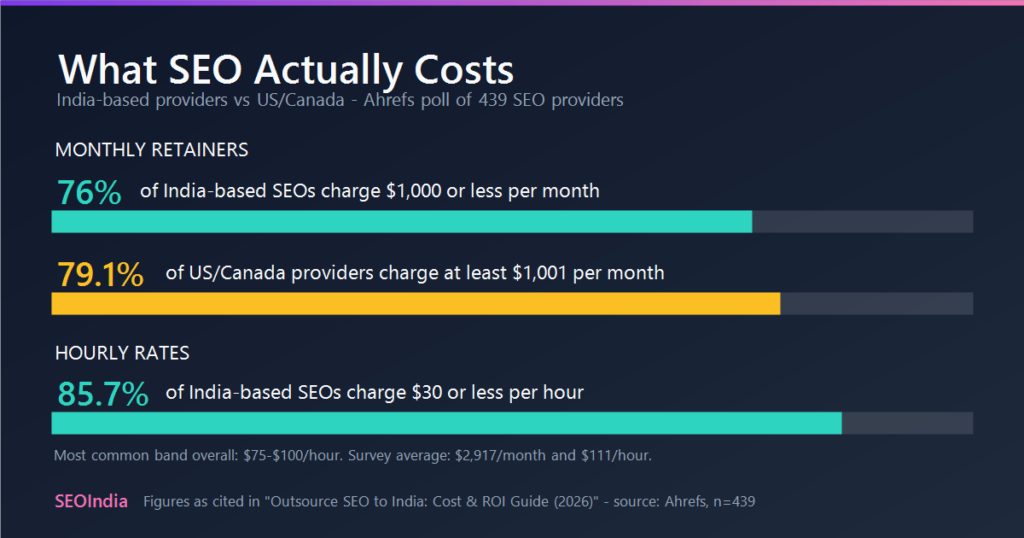
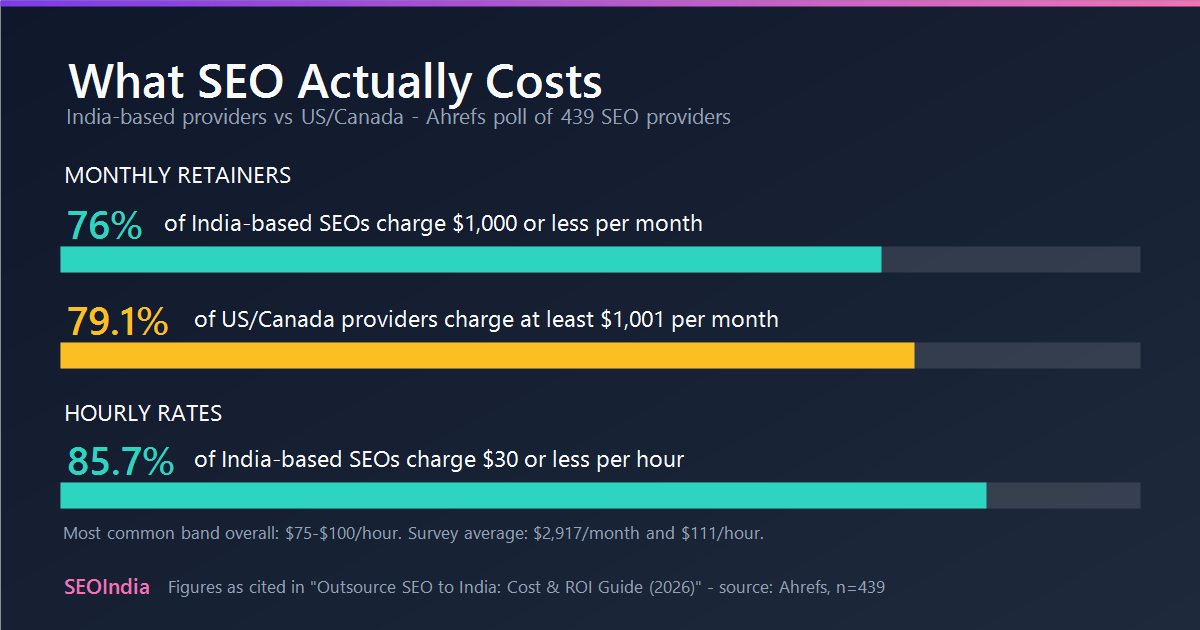
Start with the most credible baseline available. Ahrefs polled 439 SEO providers and found SEO costs average $2,917 per month overall, with an average hourly rate of $111. The most popular monthly retainer band was $501–$1,000, the most popular hourly band $75–$100, and the most popular per-project fee $2,501–$5,000. Agencies charged $3,209/month on average — 138% more than freelancers at $1,348.63/month — while consultants averaged $3,250/month and local SEO $1,557/month.
The geographic split in the same study is the headline for this article: 76% of India-based SEOs charge $1,000 or less per month, while 79.1% of US/Canada providers charge at least $1,001. On hourly rates the gap is starker still: 85.7% of India-based SEOs charge $30 or less per hour, against a $75–$100 most-common band overall.
Published price lists tell the same story from the supply side:
| Provider | Market | Published pricing |
|---|---|---|
| WebFX | US agency | SEO services from $3,000/month; cites industry averages of $1,000–$5,000/month for retainers and $75–$200/hour for consulting |
| Whitehat SEO | UK agency | SEO retainer from £1,967/month; SEO + content from £2,967/month |
| SEOValley | Indian agency | Packages from $250/month across six plans scaled from 15 to 300 keywords |
| PageTraffic | Indian agency | Plans from $499/month across four tiers (40 to 160 keywords), plus white-label and dedicated-hire models |
| RankON Technologies | Indian agency | ₹25,000 (~$300)/month basic, ₹40,000 (~$500) advanced, ₹55,000 (~$700) ecommerce |
Two corroborating datasets are worth knowing. SE Ranking’s 2024 survey of 260 agencies across the US, Canada, UK, Europe and ANZ found the most popular retainer is $500–$1,000/month, with 64% charging below $1,000 and only 2% above $5,000 — and even within the West, geography moves price: 40% of US and Canadian agencies charge over $125/hour versus only 6% of European ones. Meanwhile Backlinko’s survey of 1,200 US small business owners found actual average spend is just $497.16/month, with half spending under $1,000 per year. The gap between what US providers charge and what US small businesses can pay is the market opening Indian agencies fill. Published rate cards are only half the picture; we keep a separate breakdown of what Indian agencies actually quote, tier by tier, built from 200-plus quotes our own clients have received.
Why the cost differs (it’s economics, not corner-cutting)
The lazy explanation for the price gap is “cheap labour, cheap quality.” The accurate explanation is duller: the same deliverable is produced against completely different cost structures.
- Salary baselines. An SEO specialist’s salary in India buys a comparable standard of living at a fraction of the dollar or pound figure a Western agency must pay. The agency’s largest cost line — people — is structurally lower, so its break-even price per client is structurally lower. Nothing about the search algorithm changes with the payroll currency.
- Overheads. Office space, software procured at regional pricing, and support staff all cost less in Pune or Bhopal than in London or New York. A US agency quoting $3,000/month as a starting point is not padding margin; it is covering a cost base that makes lower prices genuinely unviable.
- A deep, competitive talent pool. India produces an enormous volume of English-speaking technical and marketing graduates, and the domestic SEO services market is intensely competitive. Competition compresses prices toward cost; cost is low; prices follow.
- Volume-based delivery models. Indian agencies typically productise SEO into tiered packages and run standardised workflows across many clients, trading bespoke strategy for process efficiency. This is exactly the trade-off you should understand before buying — more on that below.
Notice that this same logic operates within the West: 22% of North American agencies charge over $2,000/month against 9% in Europe. Price tracks the provider’s economy far more than it tracks the provider’s competence. Experience matters too — Ahrefs found SEOs with 2+ years of experience charge about 33% more — but the geography effect dwarfs it.
The four engagement models
Indian SEO firms sell in four recognisable shapes. Match the model to your situation, because most bad outcomes start with a model mismatch, not a bad vendor.
1. Keyword-tiered monthly packages
The dominant retail model: fixed monthly fees scaled by keyword count and deliverable volume. SEOValley runs six plans from 15 to 300 keywords starting at $250/month, and PageTraffic runs four tiers from 40 to 160 keywords starting at $499/month, both with account managers, on-page/off-page work and reporting included. Best for small businesses with defined targets. The weakness is inherent: “keywords tracked” is an input metric, and packages can drift into activity-for-activity’s-sake. Before comparing tiers at all, decide which services in the bundle you actually need – the cheapest ones to deliver are the ones most often padded in.
2. White-label / reseller SEO
Built specifically for Western agencies. PageTraffic’s white-label program publishes Local SEO from $299/month, National from $499/month and Ecommerce from $549/month, with no minimums, contracts or retainers — the Indian agency handles strategy, campaign setup, optimisation and reporting under the reseller’s logo, with branded client dashboards, so “your clients never know we exist.” If you are the agency owner from the opening scenario, this is your model. It is also the model demanding the most diligence, because your brand absorbs every mistake your invisible partner makes. We run the same arrangement for partner agencies, which is disclosure rather than neutrality – apply the checklist below to us too.
3. Dedicated full-time resource
You hire a named specialist who works only on your accounts — effectively offshore staff augmentation, offered by firms like PageTraffic under its “Hire Full Time Experts” model. Best when you have ongoing volume and your own strategy layer, and you want execution capacity rather than a black-box service. You take on management responsibility in exchange for control. The prior question – whether you are buying direction or delivery – is what decides between this model and a full retainer.
4. Custom project-based scoping
One-off engagements — a migration, a technical audit, a link-cleanup — scoped and priced individually. RankON, for instance, offers custom packages “tailored to meet the business requirements” alongside its fixed plans. A small paid project is also the single best vetting mechanism available, which the checklist below will use.
The ROI math, step by step (redo it with your own numbers)
Ignore vendor ROI calculators. Three pieces of arithmetic, using published prices you can verify, tell you whether this works for your situation.
Calculation 1: The reseller margin (for agencies)
Suppose you buy white-label national SEO at $499/month and resell it inside the most popular retainer band Western clients actually pay — $501–$1,000/month per Ahrefs. At a $1,000 retail price, gross margin is $501 per client per month before your account-management time. The formula to redo: (your retail price − wholesale fee − hours of your time × your loaded hourly cost) = monthly contribution per client. If your account manager spends five hours a month on the client, price that honestly; the margin survives at realistic overheads, but it is not free money.
Calculation 2: The break-even (for businesses buying direct)
Take a $499/month package. Annual cost: $5,988. The question is not “will I rank?” but “how much incremental gross profit must organic search produce to cover this?” The formula: fee ÷ gross profit per customer = new customers needed per month. A business whose average customer generates $500 in gross profit needs one incremental customer a month to break even; a $50-profit business needs ten. Run this before signing anything, with any vendor in any country — it tells you whether SEO at that price can plausibly pay for itself in your unit economics, and it takes two minutes.
Calculation 3: The alternative-cost comparison
The honest comparison for the Indian option is not “Indian agency vs. nothing” but “Indian agency vs. the Western alternative at the same budget.” Ahrefs puts the average Western freelancer at $1,348.63/month and the average agency at $3,209/month. At a $500 budget you are choosing between a structured Indian package and a few hours of a Western freelancer’s time (at $75–$100/hour, roughly five to six hours). At a $3,000 budget the calculus reverses: you can afford genuine Western senior strategy, and the case for offshoring pure execution weakens unless you are arbitraging it as an agency. There is a third column this comparison leaves out – buying a toolset and doing it yourself – whose real cost is the licence plus your own hours.
One data point should temper enthusiasm at the very bottom of the market: Backlinko found clients spending over $500/month were 53.3% more likely to be “extremely satisfied,” while those spending under $500/month were 75% more likely to be dissatisfied. That finding is about spend level, not geography — but it suggests a floor below which SEO of any provenance underdelivers. The rational way to use Indian pricing is to buy more work at a given budget, not to see how little you can spend.
When outsourcing to India is the wrong choice
This section is the one most agency blogs omit. Do not outsource SEO to India if any of the following describes you:
- Your budget is under roughly $250–$300/month. Even at Indian cost structures, the credible published floor is about $250/month. Below that you are buying automated activity, not SEO. Backlinko’s advice page bluntly calls anything below $500 — “or even $1,000 nowadays” — cheap SEO to be avoided; whether or not you accept their exact threshold, the direction is right: at some price, the only way to deliver is to fake it.
- Your rankings depend on native cultural fluency. If your content must sound like a Brooklyn estate lawyer or a Yorkshire tradesman, a writer who has never lived in your market will approximate it, and approximation shows. Hybrid setups (Indian technical and link execution, local content) work; fully offshored voice-heavy content usually doesn’t.
- You need real-time, same-timezone collaboration. India Standard Time is roughly 9.5–13.5 hours ahead of the continental US and 4.5–5.5 ahead of the UK. Good agencies schedule overlap hours; even so, if your workflow needs same-hour Slack turnarounds, the friction will grind on you daily.
- You cannot invest in oversight. Outsourced SEO is delegated, not abdicated. If nobody on your side will read reports, review link placements and sanity-check content monthly, you will not catch drift until it is expensive.
- You’re hoping cheap means cheap links. If the plan is bulk backlinks at low prices, do not do this — from India or anywhere. Google’s spam policies explicitly classify buying or selling links for ranking purposes as link spam, and state that violating sites “may rank lower in results or not appear in results at all.”
The real risks, handled honestly
The risks of offshoring SEO are real, documented — and mostly manageable, which is different from nonexistent.
Penalty risk from bad link building is the big one, because it is asymmetric: the fee is small and the cleanup is not. For a sense of scale at the extreme, The Media Captain’s founder describes being tasked with disavowing over one million low-quality backlinks for insurer SafeAuto after a Google penalty — that specific penalty isn’t attributed to overseas outsourcing, but it illustrates what unwinding toxic link profiles looks like. The mitigation is straightforward: demand link samples before signing and review live placements monthly.
Quality drift at the low end. One Australian agency’s critique of offshore SEO catalogues the buyer-reported failure modes: reply delays across time zones, “cookie-cutter campaigns full of generic SEO and sloppy content” at low price points, black-hat shortcuts, cultural disconnect from the target market, and data-security exposure. Note the source competes directly with offshore providers, so it is not neutral — but every item on that list matches real complaints, and pretending otherwise would be dishonest. Each maps to a vetting question below.
The industry’s own trust problem. Here is an uncomfortable statistic that applies to SEO providers everywhere, not just India: only 30% of small business owners would recommend their current SEO provider, and the industry’s Net Promoter Score is zero. Buying SEO is a low-trust transaction in every country. That is precisely why the vetting process matters more than the vendor’s flag.
Data security. You will hand over CMS access, analytics and possibly customer data to a company in another jurisdiction. Use scoped access (never your master admin account), a signed agreement covering confidentiality and data handling, and revoke credentials the day an engagement ends.
How to vet an Indian SEO partner: the checklist
Run every candidate through this. A good agency will pass easily; an agency that bristles at the list has told you what you needed to know. A buyer-side version of the same test goes further on the fake-guarantee patterns specifically.
- Ask exactly how they build links. Request five recent live placements for existing clients. Check the linking sites yourself: real traffic, real editorial standards? Our own note on what still earns a defensible link in 2026 is the standard we hold ourselves to. Ask directly how their approach complies with Google’s link spam policies. Vague answers about “high-DA guest posts” from someone who won’t show examples are disqualifying.
- Demand named references you can call — ideally in your market and industry. Portfolios can be fabricated; a fifteen-minute call with a real client is hard to fake.
- Review real deliverables. A redacted audit, a content brief, a monthly report from an actual client. You are checking for evidence of thinking, not just activity logs and rank-tracker screenshots. This is what evidence of thinking looks like in a real deliverable.
- Establish who actually does the work. Named team members or an anonymous pool? Will you meet the people on your account? Subcontracting chains are where quality dies.
- Set communication terms in writing: overlap hours with your timezone, response-time expectations, a named account manager, and a video call cadence. A trial exchange during the sales process previews everything.
- Keep ownership of your data. Google Analytics, Search Console and your CMS stay in accounts you own; the agency gets user-level access you can revoke. Any agency that insists on running these from its own accounts is building a hostage situation.
- Insist on outcome-linked reporting — organic sessions, conversions, revenue — not just keyword counts. Tiered keyword packages price by inputs; make sure you’re measuring outputs. In 2026 add one more line to that report: citations in AI answers, which most keyword-tiered packages do not track at all.
- Start with a paid trial project. A one-off audit or a single-page campaign, per the project-based model above, tells you more in six weeks than any sales deck. Avoid long lock-in contracts until the trial has paid off; note that some Indian white-label programs explicitly run with no minimums or contracts, so lock-in is a choice, not a necessity.
- Sanity-check the price against the work promised. If the deliverables list at $199/month would take a competent human forty hours, the deliverables are not being done by a competent human.
Frequently asked questions
How much does it cost to outsource SEO to India?
Published Indian agency retainers run from about $250/month to roughly $700/month for ecommerce-focused plans, with white-label programs for agencies from $299–$549/month. On hourly work, 85.7% of India-based SEOs charge $30/hour or less. Custom scopes and dedicated full-time hires are priced individually. For a named provider rather than a category average, our own pricing page maps deliverables to each tier.
Is Indian SEO lower quality than US or UK SEO?
Not inherently. The price gap is driven by salary and overhead economics, not by a different Google algorithm. Quality varies enormously within every market — recall that the SEO industry’s overall NPS is zero, a Western-heavy statistic. The honest caveats: at the lowest price points, corner-cutting is more likely anywhere, and native-market content nuance is a genuine limitation for offshore writers.
What is white-label SEO and why do Western agencies use it?
White-label SEO means an Indian agency delivers the work under your agency’s brand — strategy, setup, optimisation and reporting under the reseller’s logo, with branded dashboards. Agencies use it to sell SEO profitably at prices their local cost base cannot support: wholesale fees start around $299–$549/month while typical Western retainers sit at $501–$1,000/month and up.
Will Google penalize my site for using an Indian SEO company?
Google does not care where your SEO provider is located. It cares what they do. Buying links for ranking purposes is link spam under Google’s policies, and spammy tactics carry penalty risk from a vendor in Mumbai, Manchester or Miami alike. Vet the methods, not the geography.
How long until outsourced SEO pays for itself?
No honest provider guarantees a timeline – a guaranteed ranking date is itself the warning sign — organic results typically build over months, and the break-even point depends on your fee and your gross profit per customer (see the formula above: fee ÷ profit per customer = customers needed monthly). Budget for at least six to twelve months before judging the investment, and measure against conversions, not keyword counts.
If you decide the model fits, the checklist above is the whole secret — and we’re happy to be one of the agencies you run it against. Start with what a professional SEO process actually looks like and our case studies.